 By Emily Parker
Updated November 2026
A good morning routine list for kids for school turns a rushed, nagging start into a sequence your child can follow on their own. The right chart makes the steps visible, so you spend less time repeating “shoes on” and more time with your coffee. The picks below were chosen on the criteria that matter most for school mornings: a clear visual layout, durable materials, a reusable or dry-erase surface, and whether the chart covers morning steps as well as bedtime. Each one is a real Amazon listing.
Our top picks at a glance
- 1
 TOP CHOICEBest overall2 in 1 Bedtime/Morning Routine Chart for Kids Toddlers, Magnetic Chore Chart for KidsView on Amazon
- 2
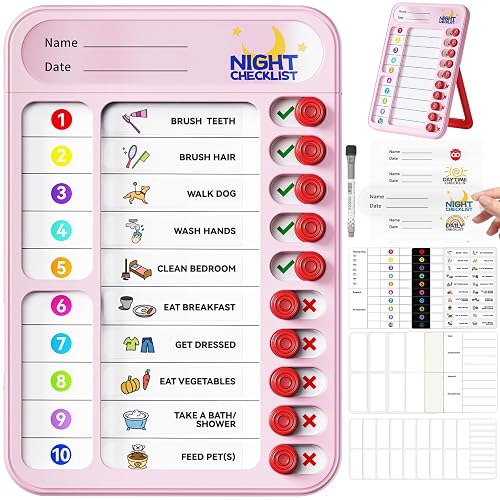 TOP CHOICEBest for dry-erase reuseVisual Schedule Checklist Board with Dry Erase Sheets, Sticker, MarkerView on Amazon
- 3
 TOP CHOICEBest for weekly planning3 in 1 Bedtime/Morning/Weekly Routine Chart for Kids, Magnetic Chore CView on Amazon
- 4
 Best for hands-on playMelissa & Doug My Daily Routines Chart, Wooden Daytime and Nighttime HView on Amazon
- 5
 Best magnetic setupMagnetic Bedtime/Morning Routine Chart for Kids -Toddler Daily SchedulView on Amazon
- 6
 Best for sliding tasks3 in 1 Upgraded Slider Bedtime/Morning/Weekly Routine Chart for Kids,View on Amazon
- 7
 Best laminated optionMorning Routine Chart for Kids – Step-by-Step Visual Schedule (9×12 LaView on Amazon
Our Top Picks
Quick Comparison
| Product | Best for | Key feature |
|---|---|---|
| 2 in 1 Bedtime/Morning Routine Chart | Younger kids and toddlers | Morning and bedtime sections |
| Visual Schedule Checklist Board | Families who want reusable charts | Dry-erase sheets and marker |
| 3 in 1 Bedtime/Morning/Weekly Routine Chart | Planning the whole week | Weekly grid plus daily routines |
| Melissa & Doug My Daily Routines Chart | Kids who like tactile activities | Wooden daytime and nighttime tracker |
| Magnetic Bedtime/Morning Routine Chart | Fridge or magnetic board setups | Magnetic pieces |
| 3 in 1 Upgraded Slider Routine Chart | Kids who like checking off tasks | Sliding task cards |
| Morning Routine Chart for Kids – 9×12 Laminated | Step-by-step self-care routines | Laminated, wipeable surface |
2 in 1 Bedtime/Morning Routine Chart for Kids Toddlers, Magnetic Chore Chart for Kids
2 in 1 Bedtime/Morning Routine Chart for Kids Toddlers, Magnetic Chore Chart for Kids, Cute Visual Schedule for Kids Schedule Board for Home, Kids Checklist to Do List ADHD Tools for Kids
Best for: Families with toddlers or preschoolers who need both morning and bedtime steps.
This chart suits parents who want one board that handles the whole day. The picture-based layout helps younger children read the steps before they can read words.
Key specs:
- Morning and bedtime sections
- Magnetic chore chart design
- Visual icons for each step
Pros:
- Covers two routines at once
- Easy for pre-readers
- Magnetic pieces move easily
Cons:
- Fewer custom options
- Small pieces need care
Bottom line: A strong first pick for parents of younger children who want morning and bedtime in one place.
Visual Schedule Checklist Board with Dry Erase Sheets, Sticker, Marker, Routine Chart for Kids, Planning
Visual Schedule Checklist Board with Dry Erase Sheets, Sticker, Marker, Routine Chart for Kids, Planning Board for Fridge Chore Chart for Kids ADHD Tools to Do List Magnetic Board with Sliders
Best for: Families who want a reusable chart they can rewrite as routines change.
Dry-erase sheets let you update tasks for a new school year or a new sibling schedule without buying another chart. Stickers add a reward element kids often enjoy.
Key specs:
- Dry-erase sheets
- Includes marker and stickers
- Board format for daily planning
Pros:
- Reusable and rewritable
- Stickers add motivation
- Flexible for different ages
Cons:
- Dry-erase surface needs gentle cleaning
- Requires you to rewrite tasks
Bottom line: Best for families who expect their routine to change often.
3 in 1 Bedtime/Morning/Weekly Routine Chart for Kids, Magnetic Chore Chart for Kid, Visual Schedule for Kid
3 in 1 Bedtime/Morning/Weekly Routine Chart for Kids, Magnetic Chore Chart for Kid, Visual Schedule for Kid Toddlers Schedule Board for Home
Best for: Parents who want to plan the whole week, not just each morning.
The weekly section lets you assign school-day tasks like packing a backpack or signing a folder on specific days, which helps kids see the bigger picture.
Key specs:
- Morning, bedtime and weekly sections
- Magnetic chore chart design
- Visual schedule layout
Pros:
- Covers the full week
- Useful for chores and homework
- Works for multiple kids
Cons:
- More setup time at the start
- Can feel busy for very young kids
Bottom line: A good fit for families who want more than a morning-only list.
Melissa & Doug My Daily Routines Chart, Wooden Daytime and Nighttime Habit Tracker with Multi-Lingual
Melissa & Doug My Daily Routines Chart, Wooden Daytime and Nighttime Habit Tracker with Multi-Lingual Stickers, Hands-On, Screen-Free Preschool Toys for Girls & Boys Ages 3+ – FSC Certified
Best for: Kids who enjoy handling real objects rather than checking boxes on paper.
Wooden pieces give children something to move from one slot to the next, which can make routines feel more like play than a list.
Key specs:
- Wooden construction
- Daytime and nighttime habit tracker
- Multi-lingual labels
Pros:
- Hands-on and engaging
- Durable wooden build
- Works for daytime and nighttime
Cons:
- Pieces can be misplaced
- Less room for custom tasks
Bottom line: A good choice for hands-on learners who need a tactile routine.
Magnetic Bedtime/Morning Routine Chart for Kids -Toddler Daily Schedule Chart at Home, Morning Checklist, Dry Erase
Magnetic Bedtime/Morning Routine Chart for Kids -Toddler Daily Schedule Chart at Home,Morning Checklist,Dry Erase Bedtime Checklist to Do List,Daily Routine Chore Chart for Kids
Best for: Families who want a magnetic chart that can sit on the fridge or a metal board.
Magnetic pieces make it easy to move tasks around and keep the chart in a visible family spot where everyone passes by.
Key specs:
- Magnetic pieces
- Morning and bedtime checklist
- Dry-erase surface
Pros:
- Easy to place on the fridge
- Dry-erase for custom tasks
- Simple to update
Cons:
- Needs a metal surface to hang
- Magnets can be small for toddlers
Bottom line: Ideal if your kitchen has a fridge or board where a magnetic chart will stay put.
3 in 1 Upgraded Slider Bedtime/Morning/Weekly Routine Chart for Kids, Magnetic Chore Chart for Kids with Cute
3 in 1 Upgraded Slider Bedtime/Morning/Weekly Routine Chart for Kids, Magnetic Chore Chart for Kids with Cute Chore Stickers, Cute Visual Schedule for Kid
Best for: Kids who like sliding or checking off each task as they finish it.
Sliders give a satisfying step-by-step feel, which helps children track progress without you prompting them every few minutes.
Key specs:
- Sliding task pieces
- Morning, bedtime and weekly sections
- Magnetic chore chart design
Pros:
- Satisfying to use
- Covers three routines
- Good for independent kids
Cons:
- Sliders can wear with heavy use
- Setup takes a few minutes
Bottom line: A strong pick for kids who respond well to a sense of progress.
Morning Routine Chart for Kids – Step-by-Step Visual Schedule (9×12 Laminated) | Self-Care Educational Chart
Morning Routine Chart for Kids – Step-by-Step Visual Schedule (9×12 Laminated) | Self-Care Educational Chart for Children, Special Needs & Autism – Morning Routine Support – English
Best for: Parents who want a single, focused morning checklist with a sturdy surface.
A laminated sheet keeps the morning steps in one clear view and can be wiped clean after breakfast, which suits busy kitchens.
Key specs:
- 9×12 inch size
- Laminated surface
- Step-by-step visual schedule
Pros:
- Wipeable and sturdy
- Focused on morning steps
- Easy to hang or post
Cons:
- Morning only, no bedtime section
- Fixed layout with no custom slots
Bottom line: The simplest option for a clear, wipeable morning list.
Buying Guide
Visual layout and readability
Pick a chart with clear icons or pictures, especially for children who cannot yet read well. Large, simple steps are easier to follow than dense text. Aim for five to eight steps per morning so the list does not overwhelm.
Good picks for this: 2 in 1 Bedtime/Morning Routine Chart, Morning Routine Chart for Kids (9×12 Laminated)
Reusable versus fixed surfaces
Dry-erase or magnetic charts let you update tasks as your child grows or your school schedule shifts. Laminated fixed charts are simpler but cannot be edited. Choose based on how often you expect the routine to change.
Good picks for this: Visual Schedule Checklist Board, Magnetic Bedtime/Morning Routine Chart
Morning and bedtime coverage
Some charts cover only mornings, while others include bedtime or the whole week. If evenings also feel chaotic, a combined chart keeps both routines consistent. Morning-only charts keep things simple for families who already have a bedtime system.
Good picks for this: 3 in 1 Bedtime/Morning/Weekly Routine Chart, 3 in 1 Upgraded Slider Routine Chart
Durability and cleaning
Charts in a kitchen or hallway get touched constantly. Wooden or laminated surfaces tend to hold up well to daily handling. Check whether the surface wipes clean, and avoid harsh cleaners on dry-erase boards.
Good picks for this: Melissa & Doug My Daily Routines Chart, Morning Routine Chart for Kids (9×12 Laminated)
Engagement and motivation
Some children respond to stickers, sliders or moving pieces, while others prefer a simple checklist. Think about your child’s temperament. A chart they enjoy using is more likely to become a habit that runs without constant reminders.
Good picks for this: Visual Schedule Checklist Board, 3 in 1 Upgraded Slider Routine Chart
FAQ
How many steps should a morning routine list have?
Most families do well with five to eight steps. Fewer steps may miss important tasks, while longer lists can feel overwhelming. Start with the essentials, like dressing, breakfast, teeth and backpack, and add more only once the routine runs smoothly.
Should a school morning chart include a reward?
Many parents use stickers or a simple weekly reward for completed routines. Keep rewards small and predictable so the focus stays on the habit itself rather than the prize.
Where should I hang a morning routine chart?
Place it at your child’s eye level near where the routine starts, such as the bedroom door or kitchen. Magnetic charts work well on a fridge, while laminated versions can be posted on a wall.
What age is a visual routine chart good for?
Picture-based charts work well from toddler age through early elementary school. Older children may prefer a written checklist or a weekly planner, so match the format to your child’s reading level.
How long does it take a child to learn a new routine?
Many children need a few weeks of consistent use before the steps feel automatic. Expect some reminders at first, and review the chart together each evening to build the habit.
Conclusion
For most families, the 2 in 1 Bedtime/Morning Routine Chart is a strong starting point, especially with younger children. Choose a dry-erase or magnetic option if your routine will change often, and a laminated chart if you want a simple, fixed morning list. Weekly and slider designs suit families who want more structure or a sense of progress. Match the chart to your child’s age and how your mornings actually run.
Sources
- Guidance from the American Academy of Pediatrics on building daily routines and healthy habits for children (healthychildren.org)
- Information on sleep and daily schedules for school-age children (cdc.gov)
Before you buy: helpful guides
Related reading
- Morning Routine for ADHD Kids: 7 Steps That Cut Down the Chaos
- Morning Routine Chart for Kids: 7 Steps to a Setup They Actually Follow
About Emily Parker
Emily Parker is part of our editorial team and reviews and edits our busy-mom life guides, checking product details against manufacturer specifications and owner feedback.


